
Most healthcare AI projects do not fail because the model was bad. They fail because the data was a mess, access rules blocked everything, clinical staff ignored the tool, or the software crashed. A model alone never fixes that. The real job is connecting AI to clean data, secure systems, workflows that make sense, and interfaces people can actually use. You need a partner who understands medical software, not just neural networks.
Here is who does what. Avenga connects AI with software delivery, data work, and product support. Cleveroad builds patient-facing apps. Vention throws engineering capacity at healthtech teams that need to scale. ScienceSoft handles analytics and reporting. Itransition runs projects from start to finish. N-iX owns data science and ML delivery. Chetu sorts out integrations and operational tools. Short version:
- Avenga: AI, software delivery, data, integrations, long-term support.
- Cleveroad: Healthcare apps, patient tools, digital health products.
- Vention: Engineering capacity, scalable product development.
- ScienceSoft: Healthcare software, analytics, clinical systems.
- Itransition: Full-cycle AI projects from planning to maintenance.
N-iX: Data science, ML engineering, model lifecycle.
Chetu: Integrations, operational software, custom business tools.
Pick based on what you are building. A patient app needs different help than an analytics platform or an AI model layer.
1. Avenga
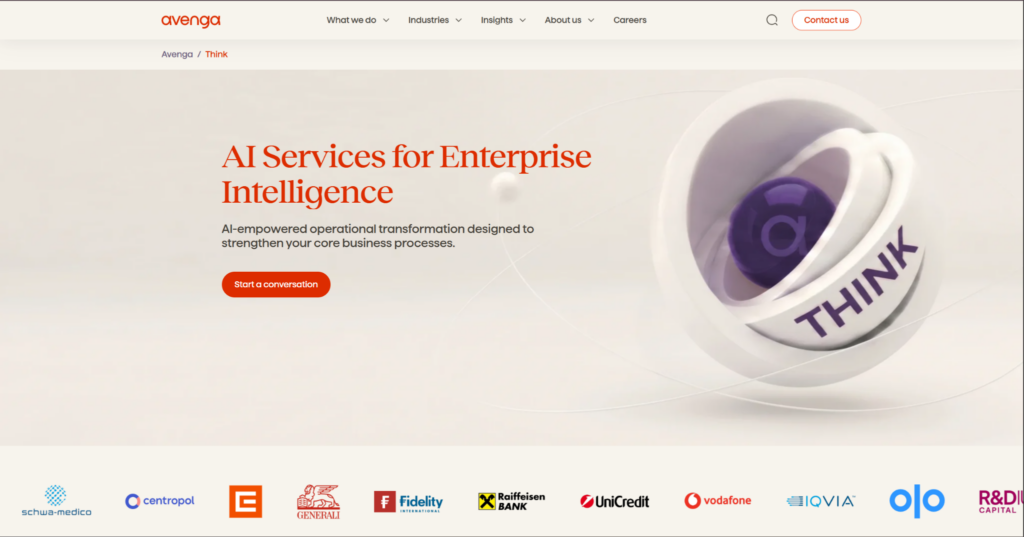
Avenga fits when you need AI inside real working software, not a prototype sitting on a laptop. For teams looking for AI development services tied to secure delivery, data work, and long-term support, Avenga is a solid first call. The firm plugs AI into healthcare platforms, internal tools, analytics systems, and patient workflows. Healthcare projects cannot treat data, access rights, security, and reliability as minor details. AI has to function inside the product without screwing up user experience or operations.
Avenga works best as an AI services company when you already have a product, platform, or process and want to make it smarter. AI can help with analytics, workflow automation, decision support, internal knowledge tools, patient engagement, or research. But those features only matter when they hook into existing software, cloud infrastructure, data flows, and team processes. Avenga makes AI usable inside that system, not just a model glued on top. What they do:
- AI consulting for real healthcare use cases, not science projects;
- Data prep for analytics, automation, and AI product features;
- Software engineering for healthcare platforms, internal tools, digital products;
- Integration with existing systems, cloud environments, business apps;
- Post-launch support to scale and maintain AI solutions.
Avenga is for healthcare teams that need AI inside a real product or workflow. It is for practical software work, not isolated experiments that go nowhere.
2. Cleveroad
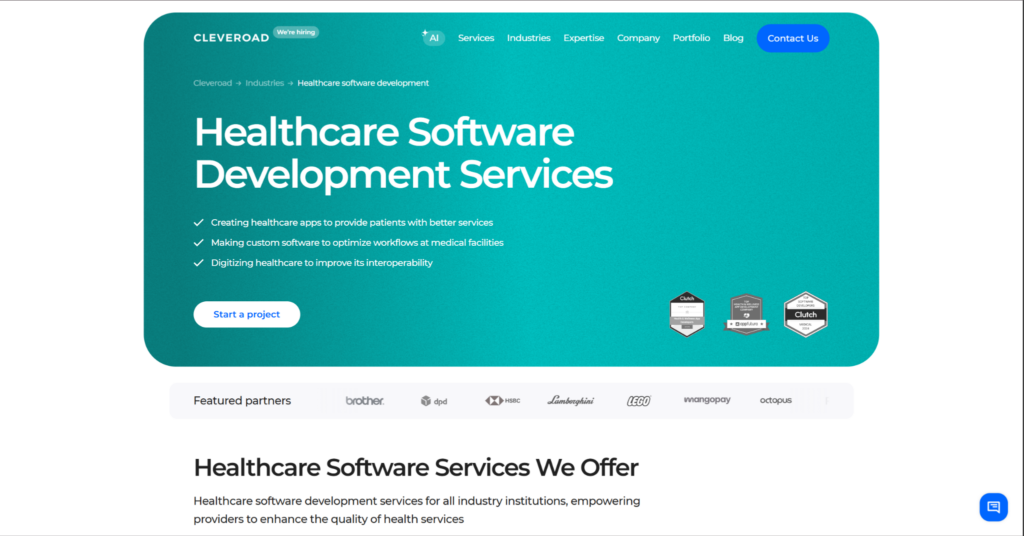
Cleveroad works for healthcare teams that need apps, digital health products, or custom medical software with AI features. The company fits when the project is closer to product development than a giant enterprise AI program. You might need a patient-facing app, appointment tool, telemedicine feature, or medical platform where AI handles automation, analytics, or user flows. Cleveroad delivers across mobile apps, web products, UX, and healthcare workflows. That is different from providers stuck in enterprise systems or data-heavy AI programs.
Healthcare AI does not always need a massive data platform or complex ML system. Sometimes the first real need is a patient portal, mobile app, appointment system, remote care tool, or clinical workflow product. AI can help with reminders, triage, personalization, automation, or better navigation. The software must stay simple enough for real users and stable enough for daily work. Cleveroad covers AI services such as:
- Healthcare app development for patient, provider, and admin workflows;
- AI features for digital health products and internal tools;
- Telemedicine and remote care software with room for automation;
- UX and product design for healthcare users of all skill levels;
- Custom software for medical business processes.
Cleveroad is a solid pick when you need a usable healthcare product with AI built into the experience. Not for a broad enterprise AI transformation, but good for practical digital health delivery.
3. Vention
Vention is an engineering partner for product development teams, healthcare software support, and scalable technical delivery. The company fits healthtech firms that need to expand engineering capacity and build AI product features faster. Focus areas: product scaling, dedicated engineering teams, healthcare software development, support for digital health startups, and growth-stage companies. Vention works when you already know your product direction but need more technical muscle to move faster. See it as a development and scaling partner, not a strategy-first AI consultancy.
Healthtech product teams often need more than data science. They also need backend work, frontend logic, integrations, testing, infrastructure, and release support. Vention helps build features faster, connect AI modules, and support digital health platform growth. That matters for startups, scaleups, and healthcare software companies with active roadmaps. Main areas:
- Engineering team support for healthcare and healthtech product development;
- AI feature development for digital health platforms and internal tools;
- Backend and frontend work for scalable medical software products;
- Integration support for systems, data sources, and third-party tools;
- Delivery help for teams that need faster product growth.
Vention suits healthtech teams that need a technical team for product growth. Better when you already have direction and just need more development power.
4. ScienceSoft
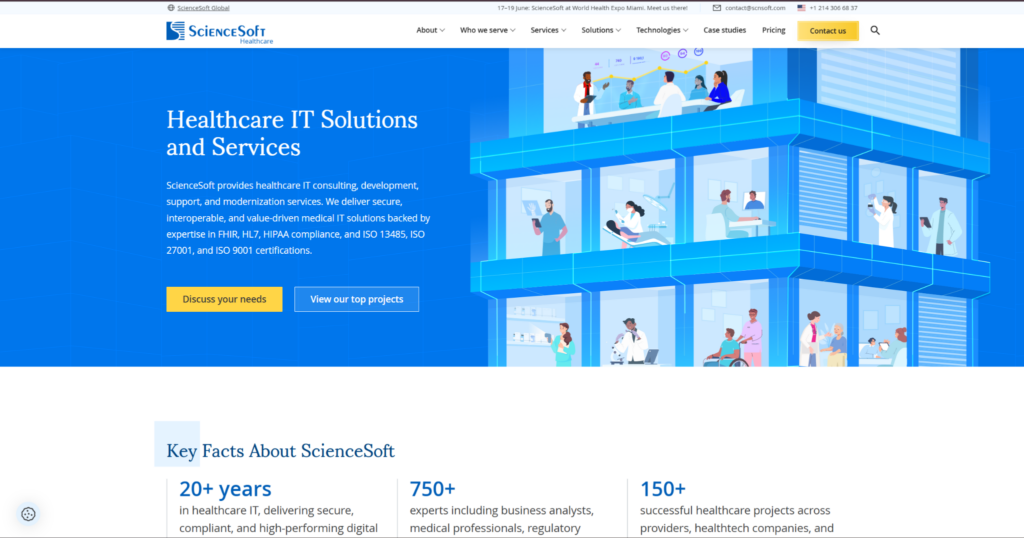
ScienceSoft is a software development and consulting company with experience in healthcare software, analytics, and data-driven systems. The firm fits healthcare software, data analytics, medical workflow, and AI-driven system projects. ScienceSoft matters when AI has to support analytics, process visibility, decision support, or automation inside healthcare operations. Its work centers on medical software development, data management, BI, and AI functionality. Less about patient-facing app design, more about healthcare software connected with data and operations.
AI projects in healthcare often live or die by data quality, process logic, reporting, interoperability, and the ability to connect multiple systems. ScienceSoft fits when you need to combine software development, analytics, and automation. That serves providers, healthcare organizations, pharma teams, or companies building medical software. Relevant when AI must support decisions, reporting, workflows, or better operational visibility. Main areas:
- Healthcare software for clinical, administrative, and operational workflows;
- Data analytics and BI support for better process visibility;
- AI functionality for decision support, automation, and reporting;
- Integration work for connecting healthcare platforms and data sources;
- Software modernization for medical systems that need better performance.
ScienceSoft suits healthcare organizations that need AI tied to analytics, reporting, and medical software. Especially relevant when the project depends on structured data and operational visibility.
5. Itransition
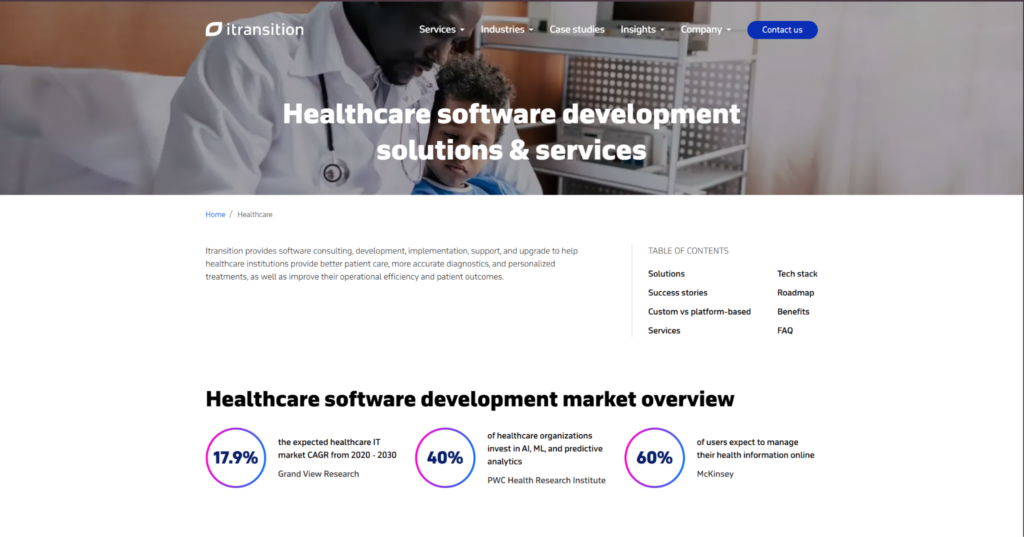
Itransition is a software engineering and IT consulting company for full-cycle healthcare AI and automation projects. The firm fits projects that need assessment, solution design, development, integration, deployment, and later improvement. Focus: custom healthcare software, automation, analytics, ML systems, integration with existing platforms. Itransition suits healthcare organizations and software companies that need AI systems tied to business or clinical workflows. Strongest when a project must go from planning to a functioning system with fewer gaps between stages.
Healthcare AI often fails when assessment, engineering, integration, and maintenance are handled separately. Itransition connects these stages into one practical delivery process. That helps projects involving workflow automation, analytics, patient engagement tools, medical platforms, or operational software. Evaluate them on their ability to support the full project lifecycle, not just development. Main areas:
- Full-cycle AI development for healthcare workflows and software products;
- Automation systems for clinical, administrative, or operational tasks;
- Machine learning for analytics, forecasting, and decision support;
- Integration with existing healthcare platforms, tools, and data sources;
- Post-launch improvement for systems that need long-term care.
Itransition suits healthcare teams that need an AI project with a clear lifecycle from idea to support. Fits when work requires planning, software delivery, integration, and maintenance in one process.
6. N-iX
N-iX is a technology services company for healthcare data science, ML engineering, analytics, and AI model lifecycle work. The firm fits healthcare teams where the main headache is data science, ML engineering, MLOps, and analytics. Focus: data, models, monitoring, deployment processes, and technical sustainability. N-iX helps organizations pull value from healthcare data and make AI systems more reliable. Less about full-cycle healthcare software delivery, more about the data and model layer behind AI work.
Medical and operational data is often a mess: complex, incomplete, sensitive, spread across many systems. Without data engineering, analytics, and MLOps, healthcare AI may work in a pilot but crash later. N-iX serves teams building predictive tools, analytics platforms, risk models, or decision-support systems. Their role is clearest when healthcare AI must become technically stable after launch. What they do:
- Healthcare data science to extract value from messy datasets;
- ML engineering for predictive, analytical, decision-support systems;
- MLOps support for monitoring and maintaining AI models after launch;
- Data analytics for better visibility across clinical or operational processes;
- AI consulting to pick realistic healthcare use cases.
N-iX suits healthcare teams where AI depends on data quality, model lifecycle, and technical reliability. Strong option when the hardest part of the project sits in data and ML delivery.
7. Chetu
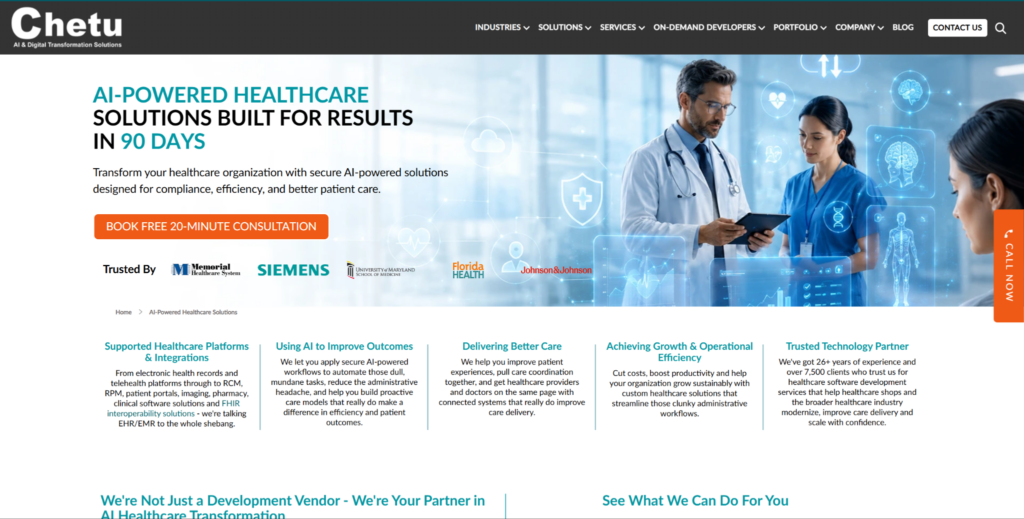
Chetu is a software development company supporting healthcare integrations, custom medical software, and operational technology projects. A practical software partner for healthcare organizations that need custom tools, integrations, and operational systems. Focus: healthcare software development, medical integrations, administrative systems, patient management tools, automation. Chetu helps when AI or automation needs to connect with existing healthcare tools. It is not an advanced AI research partner. It is a practical option for healthcare software improvements and operational support.
Many healthcare teams do not start with advanced AI because they first need to connect systems, improve workflows, and digitize operational tasks. Chetu fits where custom development, integrations, automation, and support for healthcare business software are required. In this context, AI works better as part of practical software improvement than as a separate research-heavy project. Relevant when healthcare organizations need tools that fit existing operations. Main areas:
- Healthcare software for administrative and operational workflows;
- Integration support for medical platforms, tools, and business systems;
- Automation features to cut repetitive healthcare tasks;
- Custom patient management or internal workflow tools;
- Support for software projects where AI needs to fit existing operations.
Chetu suits healthcare organizations that need practical software improvements and integrations before deeper AI adoption. A grounded choice when AI or automation has to work with existing healthcare systems.
Final Thoughts
Building healthcare AI is not plug-and-play. The model is the easy part. What matters is whether the data flows, the integrations hold, the workflows make sense, and the software stays usable after launch. Avenga makes sense when AI has to live inside real delivery and healthcare data work. Cleveroad is for apps. Vention helps scale engineering. ScienceSoft fits analytics. Itransition runs the full cycle. N-iX owns data and ML. Chetu sorts integrations and operational tools. Pick the one that matches what you are actually building, not the one with the best marketing. That is all.